
The Hidden Mathematics of 'Empty Kilometers' in Public Transport
Every morning, before a single passenger boards, a silent migration occurs in cities worldwide: thousands of buses travel from depots to starting points, completely empty. This "dead mileage" or "empty kilometers" is often dismissed as an unavoidable operational necessity. But in reality, it's one of public transport's most significant—and most overlooked—sources of waste.
For the untrained eye, it's a logistical detail. For a decision scientist, it's a complex combinatorial optimization problem hiding millions in wasted fuel, labor hours, and unnecessary carbon emissions. The truth is, empty kilometers aren't just about distance—they're about flawed system logic.
The Problem: The Illusion of Linear Routes

Traditional scheduling operates under a fundamental misconception: that a bus route is simply point A to point B. This linear thinking creates systemic inefficiency from the very beginning.
True fleet efficiency isn't determined by how buses move on their routes, but by how they transition between routes and depots. This is where Flow Logic fundamentally differs from basic routing. When static schedules fail to account for interlining—where one vehicle serves multiple different routes in a single shift—the system generates structural waste that compounds daily.
Consider these hidden cost drivers:
- The Multi-Depot Dilemma: With 3 depots and 50 routes, which bus should return where to minimize overnight repositioning? The manual solution is almost never the optimal one.
- The Transition Gap: A bus finishing morning peak service at 9:30 AM might travel 15 empty kilometers to its next assignment, simply because the schedule couldn't "see" a closer opportunity.
- The Midnight Empty Run: The largest dead mileage often occurs when vehicles return to "home" depots regardless of where they're needed next morning.
Analysis: The Mathematics of Flow
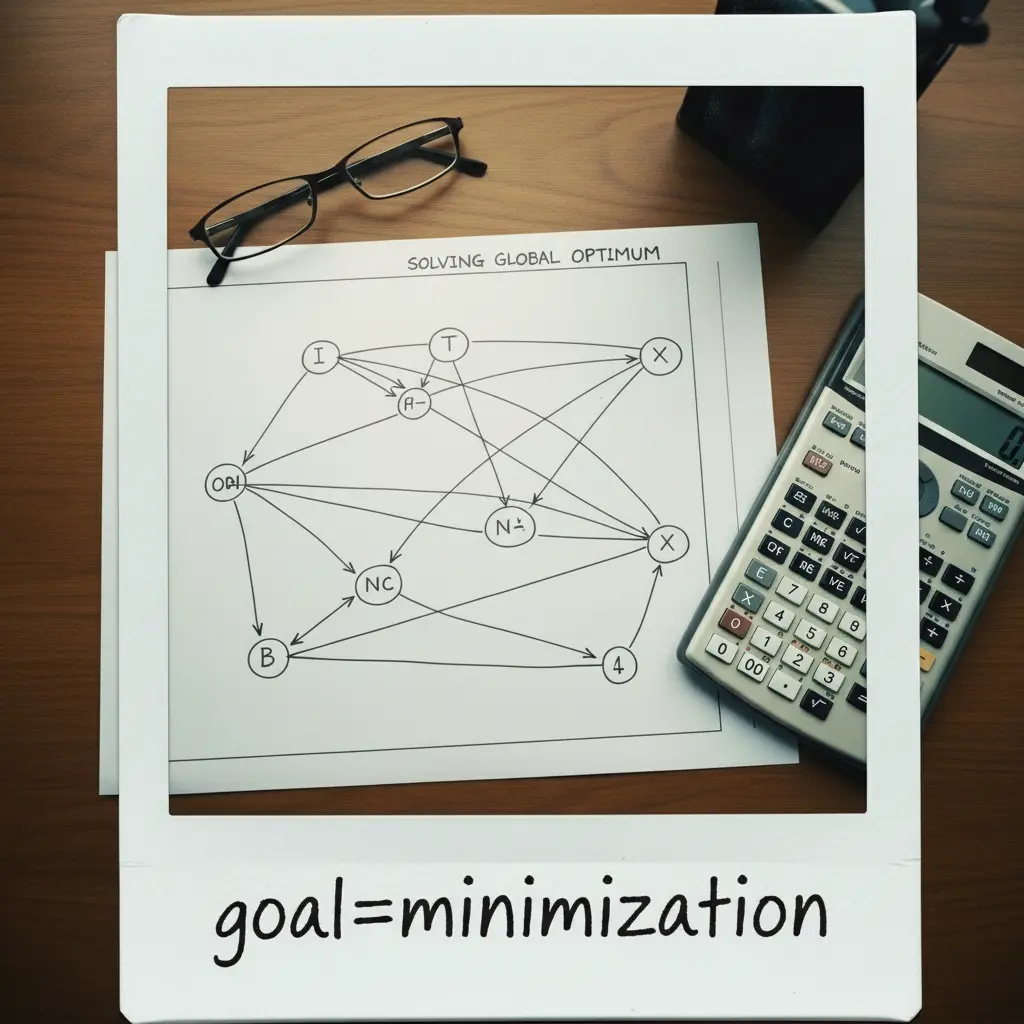
Why can't human planners solve this perfectly? Because the combinatorial complexity quickly exceeds human calculation. The number of possible vehicle-to-task assignments grows exponentially with each additional bus in your fleet.
This is where mathematical optimization changes everything. By applying Mixed-Integer Programming (MIP) techniques, we stop looking at individual buses and instead solve for the Global Optimum across the entire network.
The mathematics of empty kilometers involves modeling every possible connection between trips as a directed graph, where each "link" has a specific cost (fuel, time, wear). Advanced flow algorithms then treat the entire fleet as a single, synchronized system, finding the least-cost flow across all operations simultaneously.
The True Cost: Why Empty is Never "Free"
The expense of an empty kilometer extends far beyond fuel costs:
- Accelerated Asset Depreciation: Every "dead" turn wears engines and tires without generating passenger value.
- Labor Inefficiency: Driver hours spent repositioning empty buses are hours not serving high-demand corridors.
- Environmental Impact: With rising carbon taxes and ESG mandates, unnecessary kilometers become both financial and reputational liabilities.
- Opportunity Cost: The capital tied up in oversized fleets required to cover inefficient positioning.
Transforming Flow Logic into Tangible Savings
Eliminating empty kilometer waste requires shifting from manual scheduling to Decision Intelligence. This means implementing systems that can:
- Model the entire operational network as an interconnected flow problem.
- Evaluate thousands of "what-if" scenarios in seconds.
- Optimize depot assignments, shift transitions, and interlining opportunities simultaneously.
- Continuously adapt to real-world disruptions and changing demand patterns.
At OW, we've proven that this approach typically reduces dead mileage by 25-40%, translating directly to improved operational margins and reduced environmental impact.
Conclusion: Efficiency is Found in the Gaps

The future of efficient public transport isn't about speeding up buses on their routes—it's about eliminating the unproductive gaps between them. By applying advanced mathematical optimization to flow logic, agencies can transform empty kilometers from inevitable waste into a measurable opportunity for improvement.
The most significant efficiency gains in public transport won't come from moving passengers faster, but from moving empty buses smarter.
Discover how OW TransitOpt transforms flow logic into measurable efficiency gains
Related Posts
Beyond Routing: Why Static Scheduling is Killing Your Fleet Efficiency
Every morning, public transport planners look at maps that seem perfectly organized. But there is a silent observer that static plans fail to account for: the inherent volatility of urban life.
GTFS Data vs. Service Quality
Every public transport system runs on two essential fuels: the diesel or electricity that powers its vehicles, and the data that powers its decisions. While the first is meticulously measured and managed, the second—specifically your GTFS data—often operates in the shadows.